
RV Newbie: Essential Gear and Tips for RV Beginners

RV Newbie: Essential Gear and Tips for RV Beginners
New to RVing?
If you’re new to RVing, you’re likely feeling excited with a bit of anxiety when towing for the first time or sitting behind a giant steering wheel. We wanted to have a blog to share some ideas to help you get started on the right foot.
Like everything, our thinking and state of mind has the biggest impact how “easy” or “fun” something is and this is especially true when RVing for the first time.
Take Your Time
Often when I’m running around the RV trying to get set up quickly or hooked-up, I’m not actually in a hurry. I only think I am.
In Destin, FL I was blocking the flow of traffic while hooking up. This added pressure and as I got out of the truck (quickly) and rolled my ankle. It hurt crazy bad and in that moment I realized that I wasn’t actually moving any faster being in a “hurry”. In fact, I was doing things slower! Hence the phrase… smooth is fast.
Are you really in a hurry, or do you just think you are?
When we were boaters, we would take friends out to the lake and often return back to our slip at 8 or 9 pm. Inevitably, someone would say, “Hey, if all do this together we can get everything cleaned up in 10 minutes!” It was well-intentioned, but often far more time-consuming.
I’ve since come up with the quote, “There’s nothing more time consuming than trying to save time”.
In all the hurry, someone would forget their wallet in the glove box and I would have to drive back to the boat the following day taking a couple of hours. In time, we learned to take two cars to the lake. I would say goodbye to everyone (after making sure they had everything) and stay behind to clean-up.
Here is what I learned. Cleaning the boat was actually fun. Kinda therapeutic and even relaxing. The only thing not fun about cleaning up, setting up, or tearing down is feeling like it’s a race. With a beer in hand and good music, it was just as fun as boating itself and the same is true for RVing.
“Getting there” doesn’t need to be a race. Setting up isn’t being timed and the faster you try to go, the less enjoyable it is, for everyone. Take your time and less stuff breaks 🙂
Know your numbers
If you’re just getting started, knowing the numbers is key. Here are some important numbers to start with:
What percentage below MSRP can you buy your RV?
How heave is the hitch weight compared to my payload or CCC Cargo Carrying Capacity
How high and long is your RV?
Don’t Arrive at Night
If you’ve been watching KYD for any time at all, you’d know that we’ve done our fair share of night time driving. It’s a bad idea, especially when you’re new or you have a “new to you” RV.
If you’re still practicing your backing-up skills and don’t have your communication down pat, doing it at night can lead to divorce.
Yet, it’s unrealistic that it’s never going to happen. Life gets in the way and we all get lates starts or plans change. If you do arrive at night, be prepared with a headlamp, take extra time to walk the site and be sure to be on the same page with your travel partner on exactly where you want the eys and when they should communicate.
When your travel partner says, “Stop”… STOP! Talk it through and even get out of the vehicle to look yourself. Don’t take any chances.
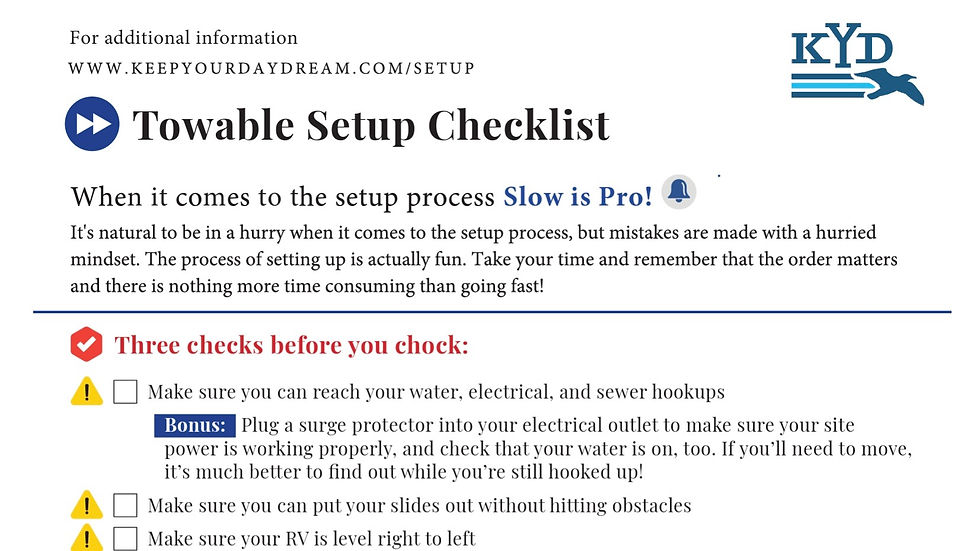
Use Set-up & Teardown Checklist
In the video above someone said, “Thanks so much, I’m still a newb” and I replied, “So am I, the moment someone thinks they know everything about RVing, they’ll be stuck under a low clearance bridge”. The order of events is important when setting up or hooking up and often there are many distractions.
Using a checklist is not just for RV newbie’s. We did a setup check-list video here.
The list does not include checking your lights, so write that in!
We also did a teardown check-list video here.
Create a Common Language with your Spouse or Travel Partner
Backing-up the trailer:
“Sorry for all the things I said when backing the trailer”. It doesn’t have to be this way, as long as you have a common language and discuss in advance what to communicate.
When I was helping a new couple back a trailer into a site, it was obvious the spouse on foot didn’t know what to point out and the spouse driving didn’t know what to ask for. The combination was frustrating for both.
When you’re learning how to back a trailer into a site, it’s helpful to first walk the site together. The drive can explain how they plan to back into the site and what would be helpful to point out. Example: “I’d like my tires to be here before I start turning into the site, but I’m worried I might clip that tree over there. Can you tell me when I get to this point and if I get close to that tree, tell me to stop”.
But when your spouse or travel partner tells you stop, stop! As a recovering impatient driver, it’s easy to think, “I know why they’re telling me to stop, it’s no big deal”. Lol. Just stop, get out and look!
Establish terms that are helpful such as “passenger” or “driver” instead of right and left. As you come up with language that is helpful, remember it and use it again.
Navigation:
Once I had one of the boys help me navigate. Once. “Oh, that was your right turn!”
The truth is, learning to communicate directions takes practice, especially when you’re towing or driving an RV and in a new city. We’ve learned to tell the driver which lane they need to be in and state the next turn just after the last one. This way the driver knows if they will be on the road for 50 feet or 50 miles.
Know how to correct trailer sway before it happens
Do you have a brake controller in your tow vehicle? If not, get one installed. Trailer brakes are key and it when it comes to correcting trailer sway, it’s your go-to move.
Many new travel trailer owners write us about the sway when semi-trucks pass. That is not sway. That’s the force of wind pushing the trailer right and thus moving the bumper of your truck left. It’s a sensation that travel trailer owners get used to.
When real sway occurs, you’ll know because it’s scary as heck and if not corrected quickly can cause an accident.
Know that your first action should be applying the trailer brakes slowly and progressively until it stops. Often the first reaction is to use the break on the truck, this does not change the physics of sway and it will persist. If your trailer brakes are set high, applying the truck brakes will also apply brakes to the trailer, but there isn’t enough difference in force to correct. In many ways, accelerating would be better, but I’ll stick with applying the trailer brakes with the lever. In most cases, it straightens out the trailer immediately.
If sway is an on-going issue, you likely don’t have enough weight in the front or your trailer and tow vehicle is not properly matched. Weight and balance have the most significant impact on preventing sway and how your trailer is loaded and important.
If you feel that your travel trailer is properly loaded and you have the right tow vehicle and sway persists, you may look into a Hensley Hitch which using engineering to solve the sway issue. This will also remove the slight sway that occurs when semi-trucks pass as the hitch will correct the movement before it reaches the truck.
I’d like to write more about trailer sway. What other questions or suggestions do you have?

Comments